Yamaha P-45 vs Casio CDP-S160: Which Fits You?
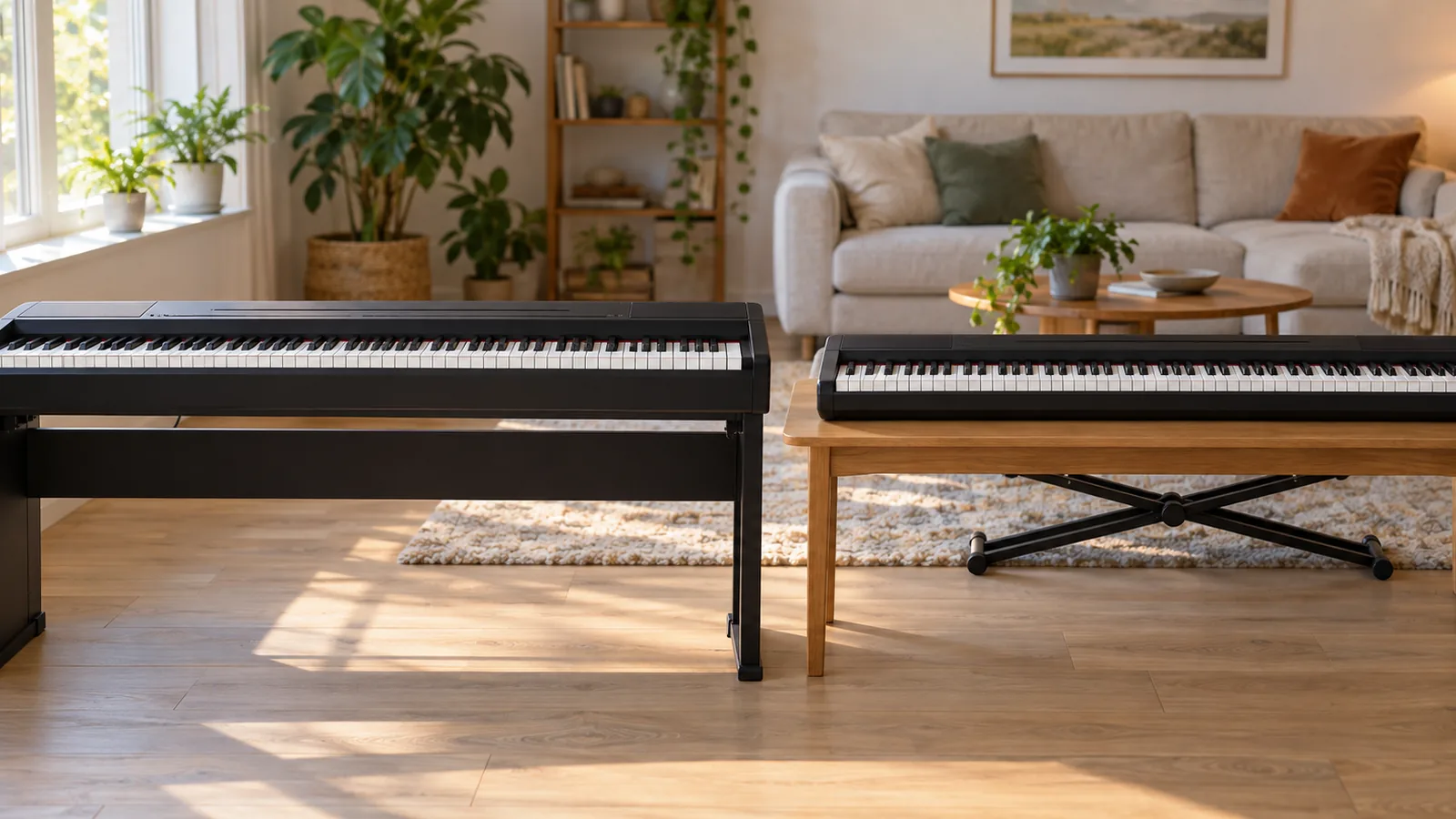
The Casio CDP-S160 suits players who move their piano or play away from an outlet, because it runs on six AA alkaline batteries for about 13 hours of continuous play. Both pianos offer 64-note polyphony, but the Yamaha P-45 runs on its PA-150 adapter or a Yamaha-preferred equivalent.
The answer flips if your piano stays in one room near a wall outlet, because the P-45 offers Hard, Medium, Soft, and Fixed touch settings on a graded hammer keyboard. The mistake to avoid is choosing by the feature list alone, since where you’ll play decides which power setup and touch feel matter most for your practice.
Key Takeaways
- About 13 hours of continuous play on alkaline cells for the Casio CDP-S160.
- Six AA alkaline batteries let the CDP-S160 run without an outlet, alongside its AC adapter.
- Four touch settings (hard, medium, soft, and fixed) on the Yamaha P-45.
- 64-note polyphony on both models, so note count won’t decide this choice.
- 16 W total speaker output on the CDP-S160, compared with 12 W on the P-45.
Quick Verdict: Choose by Where You Play
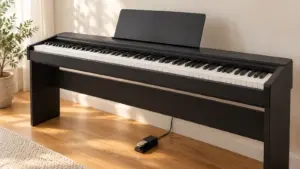
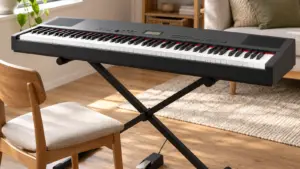
The Casio CDP-S160 suits players who move their piano or play away from an outlet, while the Yamaha 88-Key Weighted Portable Digital Piano Keyboard suits a piano that stays put.
- Pick Yamaha 88-Key Weighted Portable Digital Piano Keyboard if: your piano stays in one room near a wall outlet, because Yamaha powers it with the PA-150 or a Yamaha-preferred equivalent adapter.
- Pick Casio CDP-S160 if: you carry the piano between rooms or play where no outlet is close, because it runs on six AA alkaline batteries as well as its AC adapter.
Battery operation is the biggest practical difference between these two models. The CDP-S160 accepts the AD-A12150LW AC adapter or six AA alkaline batteries. With those cells, you can practice on a balcony, in a dorm lounge, or at a friend’s house without hunting for a socket.
The P-45 depends on mains power, so you plan your setup around a nearby outlet from day one. Both models have 64-note polyphony, so note count won’t decide this choice. Start with where the piano will sit, then compare the feel and sound.

Yamaha 88-Key Weighted Portable Digital Piano Keyboard
Our verdictBest for Home Practice
View Latest Price
Side-by-Side Specs
Both pianos have 64-note polyphony, so the real differences are in weight, size, speakers, and power. The CDP-S160 is lighter and runs on batteries, while the P-45 is deeper and taller.
| Spec | Yamaha 88-Key Weighted Portable Digital Piano Keyboard | Casio CDP-S160 |
|---|---|---|
| Dimensions | 1326 × 295 × 154 mm | 1322 × 232 × 99 mm |
| USB connectivity | USB TO HOST | USB Type-B MIDI |
| Power options | 12V AC adapter; no batteries | AC adapter or 6 AA batteries |
| Key action | GHS, 88 keys | Scaled Hammer Action Keyboard II |
| Polyphony | 64 notes | 64 notes |
| Instrument voices | 10 preset voices | 10 tones |
| Speaker power | 2 × 6 W | 8 W + 8 W |
| Weight | 25.35 lb | 23.1 lbs |
The CDP-S160 is about 2 lb lighter and 63 mm shallower, which makes it easier to move between rooms or into a bag. Its total speaker output is 16 W, compared with 12 W on the P-45. Keys and speakers are close enough that size and power will likely decide your choice.
Yamaha P-45: Best for Adjustable Touch
Touch response sets how much force a key press needs before the note sounds loud, so it’s the first thing to weigh if you want to adjust the feel. The P-45 offers four settings:
- Hard: needs firmer playing for louder notes
- Medium: a middle response between the firmest and lightest settings
- Soft: gives louder notes from lighter touches
- Fixed: keeps the same volume at any force
Play the same passage on each setting before you decide. Start on medium if you’re unsure, then move to another setting as your technique changes. The common mistake is choosing one setting and never revisiting it.
Dynamics are one reason touch matters. Playing softly and loudly teaches you control over volume, and a touch setting that tracks your force makes that control easier to hear as you practice.
Touch settings only help if the keys feel right to begin with, and that depends on the action. The P-45 has 88 keys with Yamaha’s Graded Hammer Standard (GHS) keyboard. Graded action means the bass keys feel heavier than the treble keys.
Key count tells you the range, while the action tells you how that range feels. Comparing key counts alone says nothing about how the keys respond.
Speaker output is the spec to weigh next. The P-45’s 6 W × 2 amplifiers drive two 12 cm speakers. Watts show how much sound the system can push, not how good it sounds. Room size and whether others hear you practice decide how much output you need.
The P-45 wins this criterion for players who want adjustable touch and a graded action. Pick it on this point only if you plan to use the touch settings, because a setting you never change adds nothing to your practice.
Casio CDP-S160: Best for Battery Play
If you practice in a park, on a road trip, or in a room with no outlet nearby, power decides the purchase. The Casio CDP-S160 wins this criterion. It runs on six AA batteries, and Casio rates continuous play on alkaline cells at about 13 hours.
Use these three checks to judge any digital piano for battery play:
- Count the battery slots and confirm the cell type. The CDP-S160 takes six AA alkaline batteries, so buy that exact cell type. The 13-hour rating applies to alkaline cells, not to every battery you might have on hand.
- Divide the runtime by your typical session length. A 13-hour rating works out to about six two-hour practice sessions before you need fresh cells. If you practice for an hour at a time, one set lasts far longer.
- Check for a mains option. The CDP-S160 also runs on its AD-A12150LW AC adapter, so you can switch to an outlet when the cells run low, without stopping your session.
The common mistake is buying for battery play and then forgetting the spare set. Keep a fresh set of AA alkalines in your bag, since a dead set stops your practice in the middle of a session.
Battery play matters only for some buyers. If most of your practice happens at a desk or in a living room, an outlet is always close, and the power source matters less than the feel of the keys.
For a park or travel setup, the CDP-S160’s battery option is the deciding factor.
Frequently Asked Questions
Which piano comes with a sustain pedal, Yamaha P-45 or Casio CDP-S160?
The Yamaha P-45 comes with a footswitch, and Yamaha offers half-pedal operation through its optional FC3A unit.
Can either piano use a three-pedal unit?
No, the Yamaha P-45’s only documented pedal add-on is the optional FC3A, which adds half-pedal control rather than a three-pedal unit. Half-pedal control lets you hold partial sustain, which suits pianists who want more expression than a simple on-off switch.
Should I compare the Yamaha P-45 with the P-145 instead?
No, the P-45 and CDP-S160 make the more useful comparison, because both offer 64-note polyphony and a clear split in power options. One runs on six AA alkaline batteries, while the other relies on a mains adapter, so power is the first thing to weigh.
Do these pianos connect to learning apps through USB-MIDI?
No, the Yamaha P-45 has a USB TO HOST port, but Yamaha’s specifications list MIDI as No. That means the P-45 doesn’t send MIDI data to learning apps over USB, so app-based practice won’t work with this model alone.
Is a weighted 88-key action worth it for beginners?
Yes, if you plan to practice regularly, since the keys are the part you’ll train on every session. The P-45’s Graded Hammer Standard action makes bass keys feel heavier than treble keys, and touch settings let you adjust how hard you press for louder notes.
Conclusion
If your piano will stay in a single room near an outlet, pick the Yamaha 88-Key Weighted Portable Digital Piano Keyboard and spend your early sessions on its touch settings. If you’ll move the piano between rooms or play where no outlet is close, pick the Casio CDP-S160 and buy a spare set of AA alkaline batteries before your first session. Next, list the places you’ll practice in a typical week and count how many have an outlet within reach. Then choose the model that works in most of those spots.
Sources
- https://pianistscompass.org/reviews/casio-cdp-s160/ (pianistscompass.org)
- casio.com (casio.com)
- https://www.sweetwater.com/store/detail/P45BK–yamaha-p-45-digital-piano/reviews (sweetwater.com)
- P-45 – Specs – Yamaha USA (usa.yamaha.com)