Types of Digital Pianos: How the Main Formats Differ
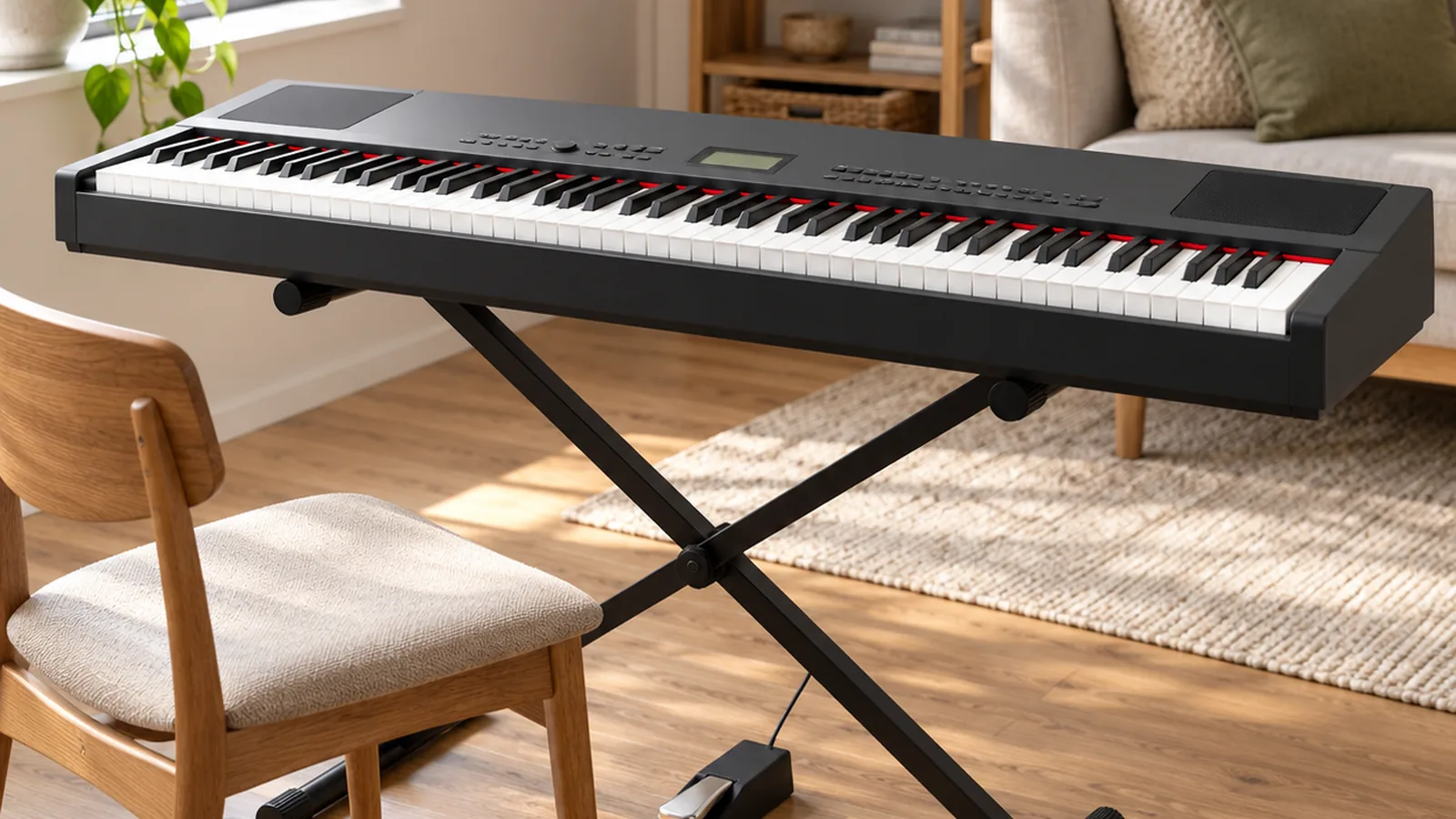
The four main types are portable (slab), console, stage, and hybrid digital pianos, and the Yamaha P-225 weighs 11.5 kg. Don’t sort them by width alone, because a console and a stage piano can be nearly the same width, so check the cabinet and stand setup instead.
Quick answer
What are the types of digital pianos?
Digital pianos come in four formats: portable (slab), console, stage, and hybrid. Portable and stage models use a keyboard-style body on a separate stand, while consoles have an integrated cabinet and pedal assembly. Hybrid is a product-category label with no universal definition, so check each model’s spec sheet.
- Portable (slab): Keyboard-style body with no cabinet; the Yamaha P-225 weighs 11.5 kg.
- Console: Furniture-style cabinet with built-in pedals and speakers; the Yamaha CLP-825 weighs 45 kg.
- Stage: Built for live amplification with balanced XLR line outputs; the Yamaha CP88 weighs 18.6 kg.
- Hybrid: Defined by each manufacturer; the Roland GP-6 pairs a PHA-50 Hybrid keyboard with hybrid wood/molded keys.
How we built this list
We built this page from 11 sources across 3 publishers, led by Yamaha, Roland and Wikipedia. Each figure names its own source, and its year where the source gives one. Where sources disagree, the article reports both figures with their sources instead of averaging them. We used published records and maker or agency pages only; we did not run tests or surveys, and figures can change after publication.
Compare the four main piano formats
Portable and stage pianos both use a keyboard-style body on a separate stand, while consoles build the pedals and speakers into a furniture-style cabinet. The size and weight of each example help you judge how much room and effort each format needs.
| Format | Cabinet and stand | Typical use | Example width (cm) | Example weight (kg) | Source |
|---|---|---|---|---|---|
| Portable/slab | Keyboard-style body, no cabinet, separate stand | Home practice, lessons, moving | 132.6 (P-225) | 11.5 (P-225) | uk.yamaha.com usa.yamaha.com |
| Console | Furniture-style cabinet with integrated pedals and speakers | Furnished home setup | 135.0 (CLP-825) | 45.0 (CLP-825) | data.yamaha.com |
| Stage | Keyboard-style body, separate stand | Live performance with amplification | 129.8 (CP88) | 18.6 (CP88) | usa.yamaha.com |
| Hybrid | No single industry definition | Varies by model | — | — | roland.com |
The width is nearly the same for the console and stage examples, so size alone won’t tell you which format you’re looking at. The console example weighs 45 kg against 11.5 kg for the portable example.
Choose a portable piano for flexible setup
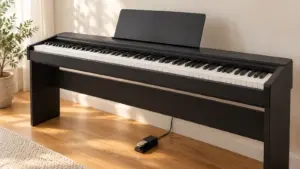
A portable piano has a keyboard-style body with no furniture cabinet, and it usually sits on a separate stand. Without a cabinet, it’s simpler to set up and move between rooms, which makes it a good fit when your practice space changes.
Yamaha’s P-225 is a useful example. It measures 1,326 mm wide and 272 mm deep, and it weighs 11.5 kg weight. These figures describe that one model, not a limit for all portable pianos, so check the spec sheet of any model you consider.
The stand and pedals may not come in the box. The P-225 manual lists its keyboard stand and three-pedal unit as separately sold accessories, and the bench may not be included either. Portable pianos suit three common uses:
- Home practice: Set it in a bedroom or living room without giving up a dedicated room for a piano.
- Lessons: Bring it to a teacher’s studio or set it up in a lesson room.
- Moving: Pack it up when you relocate, but plan to transport the stand as a separate piece.
The P-225 also lists AUX OUT, USB TO HOST, and sustain-pedal support, along with an optional pedal unit. Home digital pianos don’t follow one standard connector set, so check the rear panel of each model before you buy if you plan to record or play through speakers.
Pick a console for a furnished home setup
Console pianos are furniture-style home instruments. Their cabinet and pedal assembly are built in, so you won’t set up a separate stand.
Yamaha’s CLP-825 shows how this works. It measures 135 cm wide and 41.1 cm deep, and it weighs 45 kg. It has three pedals and built-in speakers.
Its manual parts list doesn’t include a bench, so budget for one separately. At 45 kg, it’s also heavy to move, so pick its spot before delivery.
Listed sizes vary from model to model, so the CLP-825 figures may not apply to them. Check these details before buying:
- Width and depth: Compare the listed figures with the wall space you have.
- Weight: Confirm who will move it and where it will sit.
- Pedals: Confirm the model includes the pedal assembly you want.
- Bench: Check whether one is included or whether you need to buy one.
Read the spec sheet for the exact model you’re considering. A console that fits one room may not fit another, and the pedal and bench details can change the total cost.
Use a stage piano for live performance
A stage piano is a keyboard-style instrument built for performance, and it usually sits on a separate stand. Its controls and connections are set up for live amplification. Yamaha‘s CP88 measures 129.8 cm wide and 36.4 cm deep, and it weighs 18.6 kg.
The CP88 has 88 keys and Yamaha Natural Wood Graded Hammer action.
The CP88 includes these connections:
- Balanced XLR line outputs
- Unbalanced ¼-inch line outputs
- MIDI IN and MIDI OUT
- Sustain-pedal jack
- Assignable foot-switch jack
Those connections are typical of stage pianos, but they aren’t guaranteed on every model.
Categories overlap. Synthesizers and workstations usually put more weight on many sounds and production controls, while the CP88 stays focused on piano playing.
Treat hybrid as a model-specific label
Hybrid has no single industry-wide definition. “Hybrid digital piano” is a product-category label, so each manufacturer decides what it means for its own models. Roland’s GP Series is one example. Its hybrid wood keys combine wood with molded material, and they are paired with progressive hammer action.
The GP-6 shows how this works in one model. Roland specifies it with a PHA-50 Hybrid keyboard, progressive hammer action, and hybrid wood/molded keys. The GP-9M, GP-9, and GP-6 all carry hybrid wood keys.
Roland also links hybrid-style actions to its GP, LX, and KIYOLA lines. It describes LX key construction as wooden or hybrid wood/molded, and it identifies KIYOLA with PHA-50 action.
These Roland examples don’t form a complete list of hybrid lines, even from Roland alone. Use them as a reference for Roland models, and check the spec sheet before you assume another brand’s wooden keys count as hybrid.
Note
A piano can have wooden keys without hybrid construction, so check both the key description and the action name on the spec sheet.
Frequently Asked Questions
Do stage pianos have built-in speakers?
Generally, no. Stage pianos are set up for live amplification, and the Yamaha CP88 has balanced XLR and unbalanced ¼-inch line outputs to feed a separate amp or PA system. Check the spec sheet of any stage model before you assume it can produce sound without outside equipment.
Are grand-style digital pianos different from console digital pianos?
Yes, the main difference is the cabinet. A console is a furniture-style home instrument with an integrated cabinet and pedal assembly. Check the listed width, depth, and pedal setup of any grand-style model, since those details decide how it fits your room and how its pedals are set up.
What is the difference between a digital piano and a keyboard?
The main difference is design focus. Digital pianos are built around piano playing and piano-like action, while synthesizers and workstations usually put more weight on a broad set of sounds and production controls.
Do 88 fully weighted keys define a digital piano?
No, 88 fully weighted keys don’t settle it on their own. Check the action type too, since weighted, semi-weighted, and synth actions are different designs.
Is a stage piano automatically suitable for home use?
No, a stage piano isn’t automatically a home instrument. Check each model’s jacks, pedal options, and stand needs before you assume it suits your practice space.
Conclusion
If you practice in more than one room or move often, pick a portable piano and budget for its stand and pedals separately. If you want a fixed setup that looks like furniture, choose a console and settle its spot before delivery. If you plan to play through a PA system, look for a stage piano with balanced line outputs. Then open the spec sheet for the exact model you’re considering and confirm what’s in the box, including the stand, pedals, and bench.
Sources
- P-225 – Specs – P Series – Products – Pianos – Musical Instruments – Yamaha – UK and Ireland (uk.yamaha.com)
- data.yamaha.com (data.yamaha.com)
- usa.yamaha.com (usa.yamaha.com)
- roland.com (roland.com)
- roland.com (roland.com)
- usa.yamaha.com (usa.yamaha.com)
- yamaha.com (yamaha.com)
- roland.com (roland.com)
- roland.com (roland.com)